Stop Counting Calories: Why the Best Sports Nutritionists Are Now Talking About Nutritional Density
Mathieu Delarue, a nutritional biologist working with world champions, explains why he abandoned calorie counting in favor of nutritional density, and how Nectar makes this vision practical in everyday consultations.

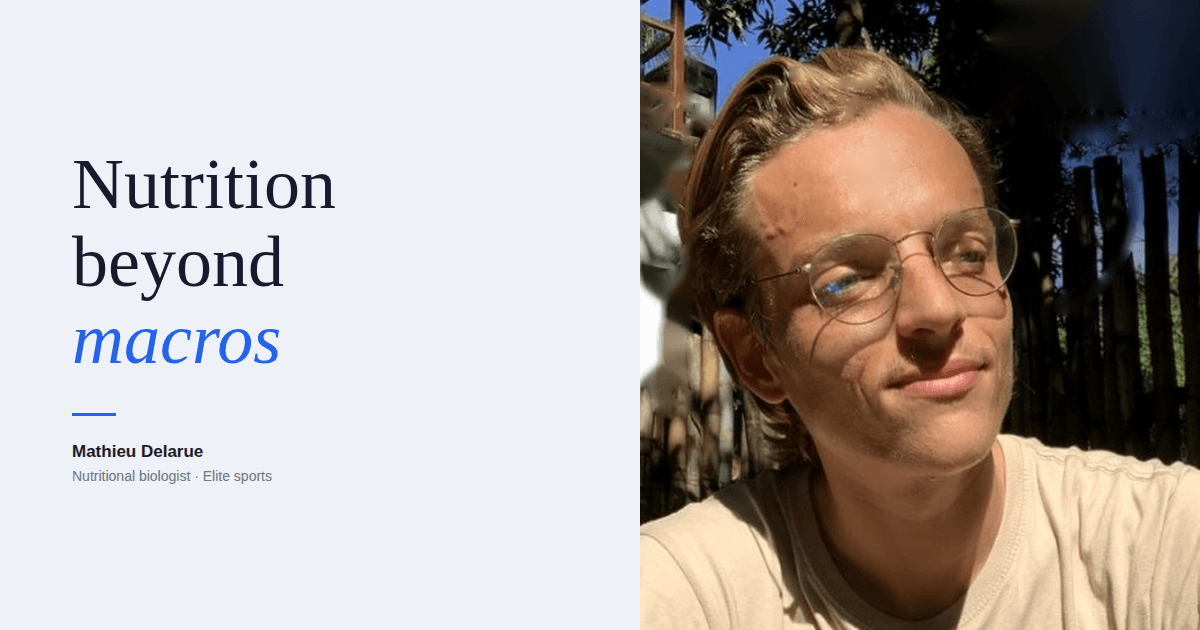
Stop Counting Calories. Why the Best Sports Nutritionists Are Now Talking About Nutritional Density.
There's a conviction quietly gaining ground in the world of elite sports nutrition. It hasn't made the cover of mainstream magazines yet. It isn't taught in every curriculum. But it's asserting itself, consultation after consultation, among the professionals who work with real high performers.
Here it is: counting calories is no longer enough. What matters is what food actually brings to the body.
Mathieu Delarue, a nutritional biologist specializing in sports nutrition, has made this his guiding principle from the very start of his practice. And he doesn't hold back.
"I want to change nutrition today. I want us to stop talking about calories, and start talking about nutritional density: vitamins, minerals, what food really does for the body. And that's exactly why I use Nectar." (Mathieu Delarue)
The Calorie: A Useful Tool Turned Counterproductive Obsession
Calories dominated nutrition for decades. They have the advantage of being simple, measurable, and universal. They helped structure broad-scale dietary recommendations, standardize food labels, and give patients a tangible reference point.
But they've also produced well-documented side effects: orthorexia, mental restriction, an anxious relationship with food, yo-yo dieting. And above all, they've obscured something fundamental: two foods can have exactly the same caloric content while having radically different effects on the body.
100 kcal of soda. 100 kcal of broccoli. Same counter. Completely different body response.
What calories don't tell you is micronutritional density: the quantity of vitamins, minerals, essential fatty acids, and antioxidants a food provides per unit consumed. And that's precisely where performance, recovery, and daily energy are determined.
What High-Level Nutritionists See That Others Don't
Mathieu works with professional surfers, world-champion powerlifters, and endurance athletes spread across four continents. In 2024-2025, his clients included Darshan Amtekela, Latin American surf champion and winner of a major tournament, and Ludivine Compin, world champion in the under-52 kg streetlifting category.
At this level, margins are razor-thin. The difference between a medal and an elimination can come down to insufficient muscle recovery, unexplained chronic fatigue, or a drop in focus during competition. Symptoms that conventional medicine often attributes to overtraining, but which, in many cases, can be traced back to a precise micronutrient deficit.
An iron deficit explaining persistent fatigue. A magnesium shortfall behind nocturnal cramps. Insufficient zinc intake slowing muscle healing and recovery. Realities invisible on a caloric balance sheet. Immediately visible on a vitamins and minerals report.
"What I'm passionate about is understanding how the biology and nutrition of each person can be adapted to get better results. Every body is different. Every case is different." (Mathieu Delarue)
Nutritional Density: What Are We Actually Talking About?
Nutritional density refers to the concentration of essential micronutrients in a food relative to its energy value or quantity. A food with high nutritional density delivers a large quantity of vitamins, minerals, and protective nutrients for relatively few calories.
Eggs, liver, sardines, dark leafy greens, legumes: high nutritional density. Ultra-processed products, sugary drinks, industrial snacks: high caloric density, low nutritional density.
For an athlete, thinking in terms of nutritional density changes everything. It's no longer about "eating less" or "eating more." It's about densifying the diet: increasing the concentration of useful nutrients without necessarily increasing volume or calories.
This is the logic Mathieu applies systematically, and that he aims to transmit to each of his patients.
"The first thing I tell my patients is: how are we going to densify your diet? How are we going to increase your vitamins and minerals?" (Mathieu Delarue)
The Real Challenge: Making It Visible and Understandable
Having a conviction is one thing. Conveying it effectively to a 22-year-old athlete who grew up with MyFitnessPal and macro tracking is quite another.
That's where the tool comes in. Mathieu uses Nectar not as a meal planning software, but as a pedagogical consultation tool. He asks his athletes to fill in their food diary for the past period, then during the consultation (in person or via video), he visually shows them how their food choices have impacted their vitamin and mineral intake.
The before-and-after comparison is at the heart of his method. If we add 3 eggs to the day, what changes for biotin, choline, selenium? If we swap an industrial snack for a handful of almonds, what shifts in magnesium or vitamin E? The patient sees the answer in real time.
"The before-and-after vitamin and mineral comparison literally saves my life. With numbers, with colors, it lands so much more easily." (Mathieu Delarue)
Nutrition stops being abstract. It becomes concrete, personal, actionable.
A Paradigm Shift That's Coming
Mathieu isn't alone. In the practices of the most advanced nutritionists (in hormonal nutrition, micronutrition, elite sports nutrition), the same shift is being observed: the cursor is moving from macros to micros.
This isn't a trend. It's a response to the evolving needs of patients and athletes, to deeper knowledge in nutritional biology, and to the emergence of tools that finally make this approach practical in everyday clinical work.
Software that only analyzes calories and macros is becoming insufficient for practitioners who want to operate at the cutting edge. Those that integrate fine micronutritional analysis (vitamins, minerals, essential fatty acids) give health professionals a level of insight that their patients can't find anywhere else.
That's Nectar's bet. And that's the choice Mathieu Delarue made.
🚀 Like Mathieu, ready to take the next step? Try Nectar free for 30 days (card required, no charge during trial). Or speak directly with Christophe, co-founder, for a personalized demo.
Ready to keep your patients engaged?
Join the dietitians who stay connected with their patients between consultations.


Join Julie, Solène, Mattias, Corrie and all the dietitians who use Nectar every day.